A valve that took a second job
Look at what the larynx is before you look at what it does for you.
Trace it back far enough and it is a sphincter. That is a ring of muscle around a hole, whose whole job is to close. The oldest version sits in air-breathing fish. There it is a simple valve of muscle. It guards the way into the swim bladder, so water cannot get in. Later animals add muscle that pulls the valve open on purpose. That way breathing can be timed. Making sound arrives last, and only in a serious way in mammals.1
So the order of business is this. Keep the lungs sealed against everything that is not air. Then let air in and out on schedule. Then, in the end, make noise. Speech is a late tenant in a building made for something else. The building was never rebuilt. Your larynx still slams shut the instant a crumb goes the wrong way. It does that rather than let you finish your sentence. The first tenant ranks first, and always will.
The parts follow from that first job. The cricoid (a full ring of cartilage at the base of the voice box) is the only complete cartilage ring anywhere in your airway. Every ring below it, all the way down the windpipe, is a C. It is open at the back, so your food pipe can bulge into the gap when you swallow.2 One place in the whole tube has to stay perfectly round at all times. That place is the mount that everything else pivots on.
If you came here from engines, the tempting map is that this ring is the throttle: the one part that sets how much air gets through. That half is off by one part, and the part it is off by is the interesting one. The cricoid governs nothing. It is the block. It is the rigid casting that holds tolerances so the moving parts have something true to work against. The actual variable aperture is the glottis. The things that move it are the arytenoids. Those are the throttle actuators. And even that is not quite right, because a throttle sets a steady flow. The folds slam shut and blow open hundreds of times a second. They turn a steady stream into a pulse train. The right engine part is the reed valve already named above. Two more places the map breaks. The larynx adds no energy of its own. An engine throttle meters a charge that will then burn. Here all the power is the air pressure the torso already made. And the reed is alive. Its mass, length, and stiffness change while it beats. No mechanical petal can do that.
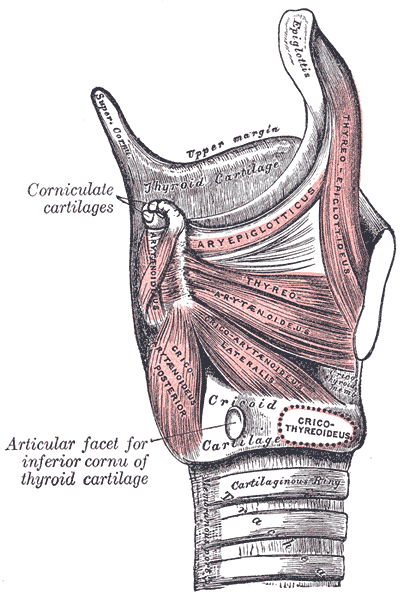
On top of the ring sits the thyroid cartilage (the big shield in front, the bump some people call an Adam’s apple). At the back sit the arytenoids (two small pyramids that swivel to open and close the folds). Between the shield and the pyramids are the vocal folds themselves. Three pieces, one hinge, and a valve.
Two muscles pulling opposite ways
The folds are not a fixed reed. Their length, thickness and stiffness change all the time while you sing. Two muscles do most of that changing by pulling against each other.
The cricothyroid runs from the ring to the shield. When it tightens it tilts the shield forward and down against the ring. That opens up the distance between the front end of the folds and their back end. The folds get stretched: longer, thinner, tighter. Tighter and thinner means faster vibration, so pitch goes up. It is the main tensor of the folds and the main pitch-raiser. It is also the only intrinsic laryngeal muscle wired by a different nerve from all the others.3 Singers meet it as head voice: high, light, easy to hear and hard to keep full.
The thyroarytenoid runs from the shield back to the pyramids. It does the opposite. Tightening it pulls the pyramids forward toward the shield. That shortens and slackens the folds: shorter, thicker, heavier, lower.4 Singers meet it as chest voice: full, loud, and not willing to go high.
Now look at where that second muscle sits. Its deeper fibres run right alongside the vocal ligament. They are called the vocalis. They are part of the body of the vocal fold itself.4 This is not a muscle that pulls on the instrument from outside. It is a muscle that is a piece of the instrument. It changes its own mass and stiffness while it vibrates. Nothing in engineering works like that. A clarinet reed does not thicken itself halfway through a phrase.

Nothing about that setup is a bug. Two muscles pulling against each other is how you get fine control out of coarse parts. A hydraulic cylinder that only pushes gives you position control that is exactly as precise as your pump. Two cylinders pushing against each other give you position control that is as precise as the difference between them. They also give you a stiffness you can set on its own, by pressing them both harder. Your larynx runs that scheme. Pitch is the balance point between the two muscles. The fullness of the tone is how hard they are both working while they hold it.
Which means singing a scale is not a set of settings. It is a running argument between two muscles with opposite interests. It runs at a finer grain than either one has on its own.
A trick for reading muscle names
Those names look like noise until you know the rule. The rule is almost the whole of anatomy’s word list: muscles are named for the two things they connect.
Crico-thyroid runs from the cricoid to the thyroid cartilage. Thyro-arytenoid runs from the thyroid cartilage to the arytenoids. The name is a set of directions between two landmarks. Once you can name the landmarks you can read the muscle without being told what it does.
Try it on something that looks worse. Sternocleidomastoid is the thick rope you can see in the side of your neck when you turn your head. Sterno is breastbone. Cleido is collarbone. Mastoid is the lump of skull behind your ear. Three landmarks, three parts to the word. Now you know roughly what happens when it shortens. You just read a nine-syllable word by knowing where things are.
Why the crack happens in the same place
You have climbed a melody and had your voice flip. It goes thin, or it breaks outright. The maddening part is that it happens at almost the same pitch every time.
That pitch region is the passaggio (Italian for passage). It is fixed because it is where the two muscles trade the lead.5 Below it, thyroarytenoid leads and the folds are short and thick. Above it, cricothyroid has to lead and the folds must be long and thin. Somewhere in the middle the workload has to move from one to the other.
Done well it is a crossfade. One eases out at the rate the other eases in. Both stay partly active the whole way. That is all that trained “mixed voice” means. It is not a third register or a third muscle. It is the two you already have, refusing to fully hand over.5 Done badly, one of them quits all at once. The balance jumps instead of sliding, and you hear the jump.
There is a second change riding along with the first, and it is the more interesting one. Thick folds and thin folds do not just sound different. They vibrate in a different shape. A thick fold opens from its bottom edge first. The opening rolls upward through the tissue like a small wave, then the whole depth slams shut. A thin fold flutters shallowly, more like a ribbon, and may not fully close at all.
That slam is where your upper harmonics come from. Go back to the start of this half: the ladder exists because the puff has a sharp edge. A crisp, complete closure gives a sharp edge and so a tall ladder: brightness, ring, carrying power. A soft or partial closure rounds the edge off. The upper rungs collapse, and you get something flutey and pretty and small.
So the climb is two jobs at once. Hand the muscles over slowly, and thin the folds slowly without losing the closure. The short way to say it: you are shedding vibrating mass on a slope. The crack is what a step looks like when the slope was supposed to be smooth.
When a sung note goes to air, two different failures can produce that feeling, and they sound different.
One is hissy. The folds stop closing all the way. Air leaks through without being turned into sound. You hear noise mixed into the note, or instead of it. The source is leaking.
The other is empty. The note was there, then it thins and dies, with no hiss to replace it. The folds may still be buzzing. The tube changed shape, so the buzz stopped coupling to the air. The filter moved. If the note went small and dry, look at the tube: tongue, jaw, soft palate, the tilt of the larynx. If it went noisy, look at the seal.
Getting better at it is not a strength problem. It is a coordination problem, in a place you cannot see.
You cannot feel any of it
This is the fact the rest of this piece leans on.
You cannot see your vocal folds. You cannot touch them either. Press anywhere on your throat and your fingers reach the outside of the shield and stop. The folds are sealed inside the cartilage box. And you cannot feel them the way you feel your hand. Everything you think you feel while singing is real, and is something else. There is vibration carried through cartilage and bone, air moving over your throat lining, the buzz in your face that voice teaching calls “the mask”. All of it is a side effect of the thing, not the thing.
The strange part is that this is not a shortage of sensors, or at least not on the face of it.
Small deep muscles across the body are fitted with muscle spindles (stretch-sensing receptors buried inside muscle) far more thickly than most. Measured per gram, the tiny muscles that aim your eye and hold your head carry densities an order of magnitude beyond big movers. One survey lists the inferior oblique of the eye at about 267 spindles per gram. It lists rectus capitis posterior at about 98. Large limb muscles in the same body are counted in single digits. The same survey is careful to say the field’s methods are inconsistent, and that the comparison should be handled gently.6
The obvious guess is physics. A part that travels a long way can report its place with a coarse ruler. A part that only twitches needs a finer one. So density would just compensate for small motion. That is right as engineering. It is incomplete as biology.
Spindles do not measure how far a muscle has gone from some fixed zero. They measure stretch, and how fast the stretch is changing, against their own current rest length. That rest length is not fixed. Each spindle has its own tiny muscle fibres inside it, called intrafusal fibres. A dedicated motor supply, the gamma motor neurons (also called fusimotor drive), shortens those inner fibres as the parent muscle shortens. The sensor stays taut. It never goes slack and goes blind. It is an auto-ranging instrument, not a fixed-scale ruler. The ticks resize.7
The stronger reason for the density is not size of motion. It is kinematic redundancy (many different shapes of a chain of joints can produce the same reading from one long sensor). The spine has about twenty-four moving segments. A long muscle that spans the whole column can only report the sum. Many different spinal shapes look identical to it. A short muscle that bridges one pair of bones, like multifidus, reports the distribution. You need one sensor per independently-moving part, or the shape is unrecoverable. That is an information problem, not a magnitude problem.8
The strongest reason is an inversion. Rectus capitis posterior minor, a deep muscle under the base of the skull, is far too small to move the head in any useful way. It is among the most spindle-dense tissue you own. The leading account is that its job is not to move the head. It is to measure where the head sits on the neck, for the balance and eye-head reflexes. Several of these deep muscles are sensors that happen to be able to contract.9
A sensor that reports to a reflex does not need a channel into your mind. If that was the job, conscious access was never built. It was not lost.
For the larynx itself, the evidence is genuinely contested. Studies from the 1950s through the 1980s reported spindles in the thyroarytenoid using traditional stains. Later immunohistochemical work argued that some of those were not spindles at all. And a recent animal study found canonical proprioceptors largely absent from intrinsic laryngeal muscle. A 2023 review of the whole question lands on unresolved. It suggests the laryngeal receptors may be odd enough in structure, with thinner capsules and fewer internal fibres, that they are simply hard to identify.10
What is not contested is the part that matters to you as a singer: whatever is down there does not report to you. Voice teachers work almost always in one way. They ask students to attend to sensations that are proxies. Direct position sense of the folds is not there to attend to.11
And notice that this is not a general failure of access. That is what makes it interesting. The command channel to your larynx stands out. Humans have a direct connection from motor cortex to the brainstem cell group that drives the laryngeal muscles. That link is absent in monkeys and weaker in apes. It is one of the leading candidates for what made voluntary speech possible at all.12 Your voluntary control of this equipment is finer than most. You just have no readout from it.
Think of a factory floor covered in sensors. All of them are wired into a control loop that works on its own and keeps the line running. None of them are wired to a screen in the control room. The instrumentation is excellent. The telemetry is fast and used all the time. It was just never routed to a display. For most of the machine’s life, no one stood in the control room who needed to look.
That is your larynx. Sensors, loops, reflexes, no dashboard.
Once you accept it, the whole odd dialect of voice teaching stops sounding like fortune telling. Spin it. Sing on the breath. Put it in the mask. Think the note before you sing it. None of those are orders to a muscle. An order to a muscle you cannot find is not a thing you can follow. They are descriptions of a result. They are handed to a nervous system. That system is very good at hunting for its own wiring, once it knows what it is hunting for. The teacher is not being vague. The teacher is aiming at the only input the system accepts.
Which raises the obvious question. It is the one the second half of this piece is about. If you cannot feel the instrument, how does anyone ever learn to play it?
References
-
Clarence Sasaki, Anatomy and development and physiology of the larynx, GI Motility online (2006).
“Viewed phylogenetically, the primary function of the larynx is its use as a sphincter, protecting the lower airway from the intrusion of liquids and food … The third function of the larynx, phonation … appears to be a late phylogenetic acquisition.” ↩
-
Anatomy, Head and Neck: Cricoid Cartilage, StatPearls, NCBI Bookshelf. The cricoid is the only complete cartilage ring encircling any part of the airway; the tracheal cartilages below it are C-shaped and open posteriorly, where the trachea abuts the oesophagus. ↩
-
Cricothyroid muscle, Wikipedia. Contraction rotates the thyroid cartilage at the cricothyroid joint, stretching, tensing and thinning the vocal folds; it is the principal tensor and pitch-raiser, and the only intrinsic laryngeal muscle not supplied by the recurrent laryngeal nerve. ↩
-
Thyroarytenoid muscle, Wikipedia.
“Its main use is to draw the arytenoid cartilages forward toward the thyroid, thus relaxing and shortening the vocal folds.” Its deeper fibres form the vocalis, a band lying against and adherent to the vocal ligament. ↩ ↩2
-
Passaggio, Wikipedia; see also Passaggio: the register transition zone in singing, Voice Science. The passaggio is a zone of several adjacent pitches rather than a single threshold. ↩ ↩2
-
Sun et al., Quantity and Distribution of Muscle Spindles in Animal and Human Muscles, International Journal of Molecular Sciences, 2024. Reported densities include inferior oblique at 266.67 spindles per gram, superior oblique at 189.47, and rectus capitis posterior at 98.31.
“We have reservations” — the authors’ own caution about concluding that fine-motor muscles necessarily carry higher spindle densities, given inconsistent counting methods across the literature. ↩
-
Uwe Proske & Simon C. Gandevia, The proprioceptive senses: their roles in signaling body shape, body position and movement, and muscle force, Physiological Reviews 92(4), 1651–1697 (2012). DOI 10.1152/physrev.00048.2011. Gamma motor neurons reset intrafusal fibre length so the spindle stays sensitive as the parent muscle shortens. ↩
-
J. E. Macintosh & Nikolai Bogduk, The biomechanics of the lumbar multifidus, Clinical Biomechanics 1(4), 205–213 (1986). Segmental fibres of multifidus span one vertebral pair and can report local orientation that a long multi-level muscle would sum and lose. ↩
-
Peck, Buxton & Nitz, A comparison of spindle concentrations in large and small muscles acting in parallel combinations, Journal of Morphology 180(3), 243–252 (1984); and Hallgren, Rowan, Ackermann et al., Implied Evidence of the Functional Role of the Rectus Capitis Posterior Muscles, Journal of the American Osteopathic Association 120(6), 395–403 (2020). The muscle is too small to move the head in a useful way; the spindle density is the point. ↩
-
Hernández-Morato, Yu & Pitman, A review of the peripheral proprioceptive apparatus in the larynx, Frontiers in Neuroanatomy 17:1114817, 2023. See also Canonical Proprioceptors Are Largely Absent in the Intrinsic Laryngeal Muscles of the Rat Larynx, Journal of Comparative Neurology.
“Between 1950 and 1987, multiple groups observed MuSp in the TA using various traditional stains… Others have found MuSp to be absent in the TA.” ↩
-
“I ask them what they can feel”: proprioception and the voice teacher’s approach, James Cook University research repository. ↩
-
Kristina Simonyan & Barry Horwitz, Laryngeal Motor Cortex and Control of Speech in Humans, The Neuroscientist, 2011. In humans the laryngeal motor cortex sits in primary motor cortex with direct projections to the brainstem nucleus ambiguus; in non-human primates it sits in premotor cortex with only indirect connections. ↩